

Two Shelved Laboratory Tables for a Biotechnology Research Facility: SystImmune, Redmond, Washington
SystImmune needed additional instrument bench space in its Redmond, Washington research laboratory without rebuilding a casework run. Labs USA supplied two forty eight inch wide laboratory tables on leveling glides, each with a full width lower shelf, plus matching spare shelves.

The Situation
SystImmune is a biotechnology company doing therapeutic research, and its Redmond, Washington laboratory is a working research space rather than a production floor. Research labs grow in a specific way: not by renovation, but by adding a station at a time as a program advances or a new instrument arrives.
That growth pattern is a poor match for laboratory casework. Fixed casework is designed around a final layout, quotes at eight to ten weeks, and usually involves plumbing, wall attachment and a contractor. None of that is proportionate when what is actually needed is somewhere to put two instruments and their consumables.
Free standing tables are the right category, but the easy version of that decision creates its own problems. An industrial catalog table is typically too deep, has no chemical resistant surface, and offers no organized storage, so supplies migrate to the floor and to the bench top around the instrument. Within a month the added surface is fully consumed by clutter.
Floor condition is the constraint people forget. Laboratory floors are often sheet vinyl with slight slope to a drain or minor variation from the slab, and an instrument bench that rocks even slightly is a problem for balances, plate readers and anything with an internal moving stage.
The Solution
Labs USA specified two forty eight inch wide laboratory tables on leveling glides, each supplied with one full width shelf, and added two matching shelves so the storage could be doubled or a shelf kept as a spare. Forty eight inches is a deliberate size: wide enough for an instrument plus working space beside it, narrow enough to fit an existing aisle without rebuilding the room.
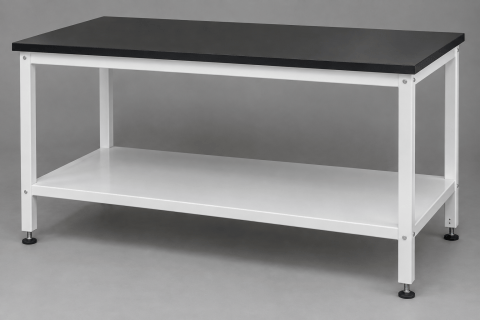
Leveling glides rather than casters were the correct choice for instrument work. Casters make a bench mobile, which sounds useful until a plate reader or a balance is sitting on it. Threaded glides let the table be trued to an imperfect floor and then stay exactly where it was set, which is what instrument repeatability actually requires.
The lower shelf does more than add storage. A shelf under the work surface gives tip boxes, reagent kits, waste containers and instrument accessories a defined home, which keeps the top clear for the instrument and the immediate task. That is the difference between a bench that stays usable and one that becomes a shelf of its own.
Supplying the extra shelves was a small decision with a long tail. A second shelf can double the storage on either table, or replace a shelf that gets damaged years later when the original part number may have changed. Ordering it with the tables costs a fraction of what a separate later order and freight would.
Both tables were specified identically, so the two stations behave the same and either instrument can move between them. The same table platform is used across the Labs USA laboratory tables and laboratory furniture ranges, which means matching stations can be added later against the same specification.
Features
Advantage
The useful decision on this project was recognizing what kind of purchase it was. Adding two instrument stations to a working research lab is not a casework project, and treating it like one costs two months of lead time and a construction coordination effort for no benefit.
At the same time, treating it as a generic furniture purchase gives up the things that matter in a lab: a surface that tolerates cleaning agents, a frame that can be trued to the floor, and storage that keeps the bench top clear. Laboratory grade tables sit exactly in between, and that is where this requirement belonged.
The leveling glide choice is the clearest example. It would have been easy to quote casters and call it flexibility, and it would have been wrong for instruments that need to sit still. Specifying for the actual use produces a bench that supports the work instead of one that has to be worked around.
Including the spare shelves is the same thinking applied to time. The cheapest moment to buy a matching component is while the original order is open, because freight is shared and the part number is current.
Benefits
- Two instrument stations added without renovating or extending casework
- Tables trued to an uneven laboratory floor and held in position for instrument work
- Consumables stored under the work surface, keeping bench tops clear
- Spare shelves on hand for future expansion or replacement
- Identical stations so instruments and methods transfer between them
- Delivered and placed without plumbing, wall attachment or a contractor
- A single specification to reorder against as the lab adds stations

A threaded leveling glide lets each leg be adjusted to the floor, then holds the table in position so instruments stay level. Representative photo.
Return on Investment
Compared with extending casework, the saving is straightforward. Casework quotes in months and brings plumbing, wall attachment and site work with it. Two free standing tables arrive as furniture, get leveled in place, and are in service immediately, which for a research program means the instrument starts producing data on arrival rather than after a fit out.
The surface and frame specification protects that spend. A laboratory grade top handles disinfectant and solvent wipe down without swelling, and a frame that can be leveled does not need shimming with whatever is at hand. Both failure modes are what turn cheap benches into replacements within a couple of years.
Storage has a quieter payback. When consumables live under the bench instead of on it, the usable work surface stays available, so the lab does not buy a third table to recover space it already paid for.
Finally, standardizing on one table specification means every later addition is a repeat order. Rooms furnished from mixed sources accumulate mismatched heights and depths, which slowly makes the whole floor harder to reconfigure.
Project Process
Requirement definition
Established that the need was two instrument stations in an operating research laboratory, not a casework extension.
Size selection
Chose a forty eight inch width to fit an existing aisle while leaving working space beside each instrument.
Base specification
Specified leveling glides rather than casters so each table could be trued to the floor and then stay in position.
Storage specification
Added a full width lower shelf per table, plus two matching spare shelves in the same order.
Order and freight
Released the order with freight added so the tables and shelves shipped together to the Redmond facility.
Placement
Tables were positioned and leveled on arrival with no plumbing or wall attachment required.
Laboratory Furniture in Redmond and the Puget Sound Region
Redmond sits inside one of the densest biotechnology and life science corridors in the country, along with Bothell, Bellevue, Seattle and the South Lake Union research cluster. The work there is heavily program driven, which means laboratories are reconfigured often and rarely have the luxury of pausing a program for a construction schedule.
That is why free standing, laboratory grade furniture does so well in this market. A bench that can be leveled, cleaned and moved supports a lab that changes with the science, and it can be added one station at a time as funding and instruments arrive rather than in a single capital project.
Labs USA supplies laboratory tables, casework, shelving, fume hoods and extraction equipment throughout Washington, including Redmond, Bothell, Seattle, Bellevue, Tacoma and Spokane. Call (801) 855-8560 to size stations for your instruments, or browse the laboratory furniture hub.
Shop Laboratory Workbenches Online
Buy select items directly from our online store, or request a quote for volume, custom sizes and freight-rated orders.

Frequently Asked Questions
Should a laboratory table have casters or leveling glides?
Leveling glides for instrument work, casters only when the bench genuinely needs to move. Glides let you true the table to an uneven floor and then keep it there, which is what balances, plate readers and anything with a moving stage require. Casters trade that stability for mobility that most instrument benches never use.
Why add a lower shelf instead of a cabinet?
A shelf keeps consumables and accessories within reach and visible, adds no doors to open in a gloved workflow, and does not enclose a space that then needs cleaning inside. For instrument support storage it is usually the more practical choice, and it is far less expensive than casework.
How wide should an instrument table be?
Wide enough for the instrument plus working space beside it, and narrow enough not to block the aisle. Forty eight inches is a common answer for a single instrument station. Measure the instrument footprint and the clearance it needs for doors, trays and service access before choosing.
Is it worth ordering spare shelves up front?
Often yes. Adding a matching shelf to an open order shares freight and locks in the current part, while a later order pays freight on a single item and may face a changed specification. On this project two extra shelves were included for that reason.
Do free standing laboratory tables need installation?
No. They arrive as furniture, are positioned, and are leveled with the threaded glides. There is no plumbing, wall attachment or contractor coordination, which is why they suit an operating laboratory that cannot shut down for a fit out.
Can more matching tables be added later?
Yes. Because both tables were built to one specification, additional stations can be ordered against the same configuration so heights, depths and surfaces continue to match across the room.
Adding Instrument Stations to a Working Laboratory?
Labs USA specifies laboratory tables, shelves and support furniture around the instruments and the floor you actually have, and ships without a construction schedule attached. Call (801) 855-8560 or request a quote.
Get a Free Quote Call (801) 855-8560